entering storm drains or local waterways.
That's why drainage deserves attention when evaluating a property.
Look beyond the house itself.
Walk around the lot and consider:
Where does the water appear to go?
Pay particular attention to:
- The area immediately surrounding the foundation
- Downspouts
- The bottom of slopes
- Low areas of the yard
- Driveway edges
- Walkways
- Patio areas
- Retaining walls
- Window wells
- Basement entrances
- Areas where leaves and debris repeatedly collect
You don't need to determine whether the drainage system is adequate during a showing.
Instead, identify areas that may deserve closer inspection later.
🏡 Mature Trees Can Be Beautiful—and They Come With Maintenance
One of the things that makes many Morris County neighborhoods so appealing is mature landscaping.
Large trees can provide:
- Shade
- Privacy
- Seasonal color
- A more established appearance
- Natural screening between neighboring properties
- Character around older homes
- Outdoor comfort during warmer months
But mature trees also require maintenance.
A property with several large trees may involve more seasonal cleanup than a newer home with younger landscaping.
During a fall showing, take a few minutes to look upward.
Are there large branches extending over the roof?
Are trees close to the house?
Are there branches over the driveway?
Are trees located near utility lines?
Do any branches appear dead or damaged?
These aren't necessarily reasons to reject a property.
They're reasons to understand the property you're buying.
If you have concerns about tree health or potential hazards, a qualified tree professional or arborist can provide advice specific to the property.
🍁 The Amount of Leaf Cleanup Can Be Surprisingly Different From House to House
Two homes can have similarly sized yards but completely different maintenance requirements.
Why?
Trees.
A relatively modest property surrounded by mature deciduous trees can produce a surprising amount of seasonal cleanup.
Meanwhile, a larger property with fewer mature trees may require less leaf management.
Think about your lifestyle.
If you love gardening and spending weekends outside, seasonal yard work may be something you enjoy.
If you're looking for a low-maintenance property because you travel frequently or simply don't want to spend your weekends maintaining a large yard, the same landscaping could feel very different.
This is one reason I encourage buyers to evaluate the lifestyle that comes with the property—not just the property itself.
🧹 Don't Just Look at the Yard—Look at Where Leaves Go
A beautiful backyard can still require a significant amount of work.
Look at the property's:
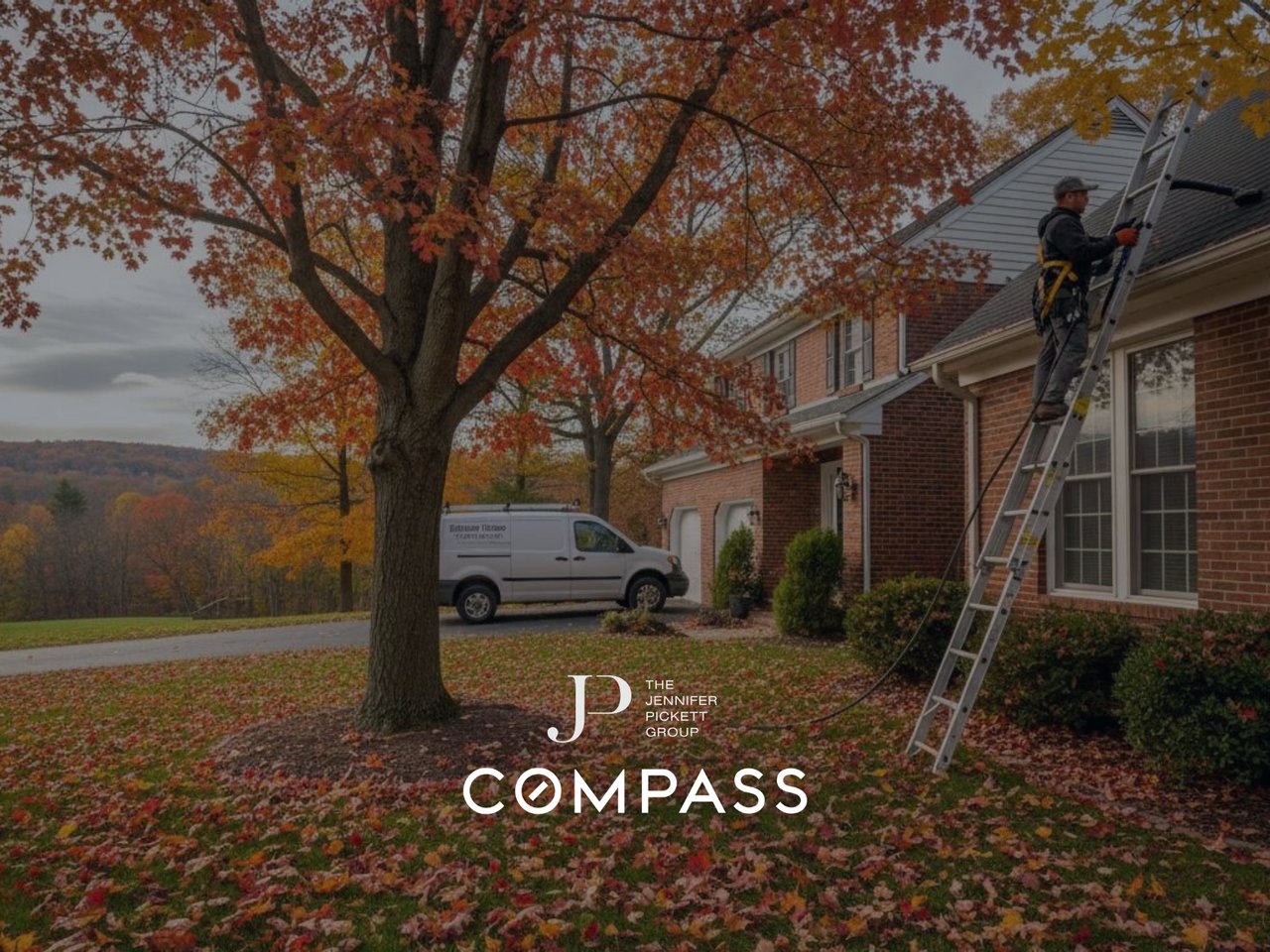
Gutters
Leaves from nearby trees can end up in gutters and downspouts.
New Jersey's Department of Banking and Insurance specifically recommends cleaning gutters and downspouts so they can drain properly as part of preparing a home for severe weather.
Downspouts
Check where downspouts discharge water.
You want to understand whether water is being directed away from the home appropriately. Rutgers also discusses directing roof runoff toward suitable permeable areas while avoiding redirecting water toward neighboring properties.
Drainage Areas
Look for drains, swales, grading, or other visible drainage features.
Leaves can sometimes accumulate in these locations, making them easier to identify.
Driveways and Walkways
A property with lots of trees may require more frequent cleanup of walkways, stairs, and driveways during autumn.
That's a small detail—but one that can become part of your regular homeownership routine.
🌳 Think About the Trees During All Four Seasons
Fall is visually impressive, but don't let the beautiful foliage tell the entire story.
Try to imagine the property in January.
When the leaves disappear:
- What will the backyard look like?
- Will the neighboring homes become more visible?
- Will the property feel more exposed?
- Will the trees still provide privacy?
- Will the driveway be more exposed to weather?
- Will branches overhang areas where snow and ice could create concerns?
Then imagine summer.
- How much shade will the trees provide?
- Will the backyard receive enough sunlight?
- Will the landscaping require regular maintenance?
- Are there areas where grass struggles because of heavy shade?
A property changes throughout the year.
That matters when you're making a long-term home purchase.
🏞️ Pay Attention to Slopes and Low Areas
Fall leaves can make changes in elevation easier to see.
If leaves consistently gather at the bottom of a slope, that may simply be natural.
But it can also prompt a buyer to ask questions about how rainwater moves through the property.
This is especially relevant in parts of Morris County where properties may have:
- Sloping backyards
- Hillside settings
- Raised homes
- Retaining walls
- Long driveways
- Multiple levels of outdoor space
A sloped property isn't inherently problematic.
In fact, it can provide beautiful views, privacy, interesting landscaping opportunities, and architectural character.
The important question is:
Does the property work for you?
Consider how the terrain affects maintenance, drainage, outdoor living, children or pets, gardening, parking, and future plans.
💧 Look for Signs That Deserve a Closer Inspection
A showing isn't a professional inspection.
Still, buyers can pay attention to visible clues.
For example, you may notice:
- Persistent standing water
- Soil erosion
- Exposed roots
- Water staining
- Damp-looking areas near the foundation
- Damaged retaining walls
- Cracked walkways
- Unusually soft ground
- Gutters overflowing during rainfall
- Downspouts discharging directly beside the foundation
None of these observations automatically tells you what is happening beneath the surface.
But they can help you develop better questions.
That's where professional due diligence becomes important.
If something concerns you, discuss it with your home inspector, contractor, engineer, drainage professional, or other appropriate specialist rather than trying to diagnose the issue yourself.
🍃 Don't Assume Every Leaf Needs to Be Removed
Interestingly, fall leaves aren't necessarily something that homeowners need to eliminate completely.
Rutgers New Jersey Agricultural Experiment Station has published guidance on leaving some leaves in appropriate landscape areas and using leaves as a resource rather than treating all leaf material as waste.
The practical approach depends on where the leaves are located.
Leaves sitting in a garden bed may be handled differently from leaves blocking a drainage area, covering a walkway, or accumulating against a home's foundation.
For homeowners, the important distinction is between natural leaf cover and leaves creating a maintenance or drainage issue.
🏠 What This Means for Buyers Looking at Older Morris County Homes
Morris County has a wide range of housing—from newer construction to homes that have been standing for decades.
Older homes often come with mature landscapes.
That can be one of their greatest charms.
But it can also mean:
- Larger established trees
- Older drainage systems
- Mature root systems
- More extensive landscaping
- Older gutters and downspouts
- Retaining walls
- Older driveways and walkways
- Landscaping that has evolved over decades
Don't automatically view these things as negatives.
Instead, consider them part of the property's overall story.
A home with mature trees and landscaping may offer something that is difficult to recreate quickly.
At the same time, you should understand the maintenance responsibilities that come with that setting.
🔎 A Simple Fall Property Walkaround for Morris County Buyers
When you're touring a home in the fall, take five extra minutes outside.
Look at the roof
Can you see areas where leaves or branches are accumulating?
Look at the gutters
Are they clean and properly positioned?
Look at the downspouts
Where does the water appear to go?
Look at the foundation
Do you see obvious signs of moisture or water management concerns?
Look at the yard
Where are leaves naturally collecting?
Look at the trees
Are there large branches near the house, driveway, or outdoor living areas?
Look at the slope
Where does the property rise and fall?
Look at retaining walls
Do they appear maintained?
Look at the driveway
Does its slope and condition work for your needs?
Look at the backyard
How much of the space is genuinely usable?
Look beyond the property line
What will the view look like when the leaves disappear?
Think about maintenance
How much work will this yard require in spring, summer, fall, and winter?
🧠 The Bigger Lesson: You're Buying the Property, Not Just the House
One of my favorite things to remind buyers is that a home purchase is about much more than four walls.
You're buying the:
- House
- Lot
- Landscaping
- Terrain
- Street
- Neighborhood
- Surroundings
- Maintenance responsibilities
- Future possibilities
A kitchen can be renovated.
Paint can be changed.
Light fixtures can be replaced.
But the basic relationship between a home, its lot, mature trees, neighboring properties, and terrain is much harder to change.
That's why I encourage buyers to slow down and look beyond the obvious.
Fall is actually a wonderful season for this.
The leaves are beautiful—but they're also telling you something about the property.
⭐ Jennifer's Local Tip
When you're touring a Morris County home in the fall, don't just look at how beautiful the property is with the leaves on the trees. Look at what the leaves are showing you.
Where they collect.
Where water may travel.
How much shade the property receives.
How many mature trees surround the home.
How much outdoor maintenance the property may require.
And what the property might look like once the leaves are gone.
Those small observations can help you ask better questions during your due diligence—and ultimately give you a more complete understanding of the home you're considering.
Frequently Asked Questions
Do leaves around a foundation automatically indicate a drainage problem?
No. Leaves naturally collect around homes, landscaping, fences, and low areas.
However, if you notice persistent moisture, standing water, erosion, or other concerns, it may be worth having the area evaluated by an appropriate professional.
Are mature trees a good thing when buying a home?
Mature trees can provide shade, privacy, beauty, and character. They can also require ongoing maintenance.
The right question isn't simply whether a property has mature trees. It's whether the trees and landscaping work for your lifestyle and whether they're properly maintained.
Should buyers worry about leaves in the gutters?
Leaves can contribute to clogged gutters and downspouts, which is why regular maintenance is important. New Jersey's Department of Banking and Insurance recommends keeping gutters and downspouts clear so they can drain properly.
Can fall leaves reveal drainage problems?
They can sometimes provide clues about how water and debris move across a property, but leaves alone cannot diagnose a drainage problem.
If you notice something concerning, professional evaluation is the appropriate next step.
Should I avoid a home with a sloped yard?
Not necessarily.
Sloped properties can offer privacy, views, interesting landscaping, and unique architecture. They may also come with additional considerations involving drainage, landscaping, accessibility, and maintenance.
The important thing is understanding the property before purchasing.
What should I ask about mature trees?
Consider asking about:
- Previous tree removal
- Recent tree work
- Known tree issues
- Maintenance history
- Trees close to the house
- Trees near utility lines
- Any professional tree evaluations
If you're concerned about a particular tree, consider consulting a qualified arborist.
Final Thoughts
Morris County's mature trees are part of what makes so many of its neighborhoods special.
From Morristown and Morris Township to Madison, Chatham, Denville, Randolph, Mendham, Chester, Parsippany, Rockaway, and surrounding communities, the landscape can change dramatically from one property to another.
Fall gives buyers a unique opportunity to slow down and observe those differences.
Don't just admire the colors.
Look at the yard.
Look at the trees.
Look at the drainage.
Look at the terrain.
Look at the maintenance.
And most importantly, think about whether the property will still work for your lifestyle after the leaves are gone and the season changes.
The prettiest property isn't always the easiest property to own—and understanding the difference is part of buying wisely.
If you're considering buying a home in Morris County, NJ, I'd be happy to help you look beyond the listing photos and understand the property, neighborhood, and lifestyle that come with your purchase.
SEO Keywords
Primary Keywords:
Morris County NJ real estate, buying a home in Morris County NJ, Morris County homebuyers
Secondary Keywords:
fall home buying Morris County NJ, mature trees Morris County homes, drainage when buying a home, Morris County NJ properties, buying a home with mature landscaping, Morris County home maintenance, NJ home inspection, Morris County neighborhoods
Long-Tail Keywords:
what to look for when buying a home in Morris County NJ, buying a home with mature trees in New Jersey, drainage concerns when buying a house in Morris County, what fall leaves reveal about a property, things buyers should notice when viewing a home in fall